Saturday, April 30, 2022

MUSEO DEL PRADO

 First and foremost, Jannette and Seth arrived in Alcalá on April 28. I am so grateful to have them with me finally.


Second, on April 29 we made our way to the Prado Museum, one of the world's most amazing collections of art and sculpture. We had a wonderful time learning about some of its works and, for us, to "visit" some of our old favorites. Below are some of those "old friends":

Francisco de Zurbarán, Agnus Dei (Lamb of God) (1635-1640): this work demonstrates two vital aspects of the Savior's atonement: 1) the binding of his feet shows how the politics passed judgement on him and sentenced him to death; the gentle, submissive posture of the lambs head is a powerful reminder that it was Christ who gave his life not the political authorities who condemned him


Albrecht Durer, Self-Portrait (1498). A German painter, Durer was seen by his peers as a craftsman while he desired to be considered as a nobleman. Durer represents himself as the person that he hoped others would consider him.
Francisco de Ribalta, Christ embracing St Bernard (1625-1627). This painting is derived from an ecstatic vision that St. Bernard had while pleading for forgiveness before a statue of the crucified Christ. He sees in vision the figure of the Savior descend from the cross and embrace him. Note the benevolent look that of the Christ figure as he reaches for St. Bernard. While St. Bernard's brow is furrowed, depicting the anguish of his soul, the calm on his face corresponds to the forgiving gaze of the Savior. In the background are witness of the event. In many ways we all seek the balm of forgiveness and once experienced we become witnesses of the love that only the Savior of the world can give. We all sing the words of St. Bernard found in Jesus the Very Thought of Thee.
Diego de Velázquez, The Crucified Christ (1632). I have over the years seem many, many representations of the crucifixion but none have had the deeply spiritual impact that this has had on me. Strangely, this is not a dead Christ, but one that submits to the will of the Father; his downward gaze reminds me of Zurbarán's Agneus dei. Though his physical body is submitted to the pains of the law, his role of Savior can never diminish. Note that his gaze is toward the wound in his side. A reminder that he has given his all for each of us as we turn to Him and accept his offering.
Francisco de Goya, The Countess of Chinchón (1800). I have long loved this painting for the subtlety of its composition. Here we have a beautiful young women sitting in her chair, gazing off into the distance. She is placed in a blank space. Her story is a sad one. She was married to Manuel Godoy, a high official during the reign of Charles IV of Spain. Sadly, her husband was not faithful to his wife having maintained a relationship with the queen, María Luisa de Parma. Here we find the countess sitting, alone, in a darkened space. On her left hand is a ring bearing the image of her unfaithful husband. As she gazes forlornly into that nothingness, she wraps her arms around her stomach: she is pregnant. This painting evokes tremendous sympathy for this abandoned woman.
Diego de Velázquez, La meninas (1656). One of the world's greatest art treasures, the painter plays with space and the relationship of the artist to his subjects (even each of us as we stand looking at him and he is looking at us). Velázquez is breaking the rules that had governed artistic production, especially the Councils of Trent that placed a high priority on art that was simple, uncluttered, and spoke "truth." The works challenges the observer to enter into a "philosophical" debate over the role of art and its intersection with what we define as "reality" (closely aligned with theatre's breaking of the fourth wall that normally separates the fiction on the stage from the audience). Here, Velázquez pushes the observer into the frame.


And now, for some new favorites:

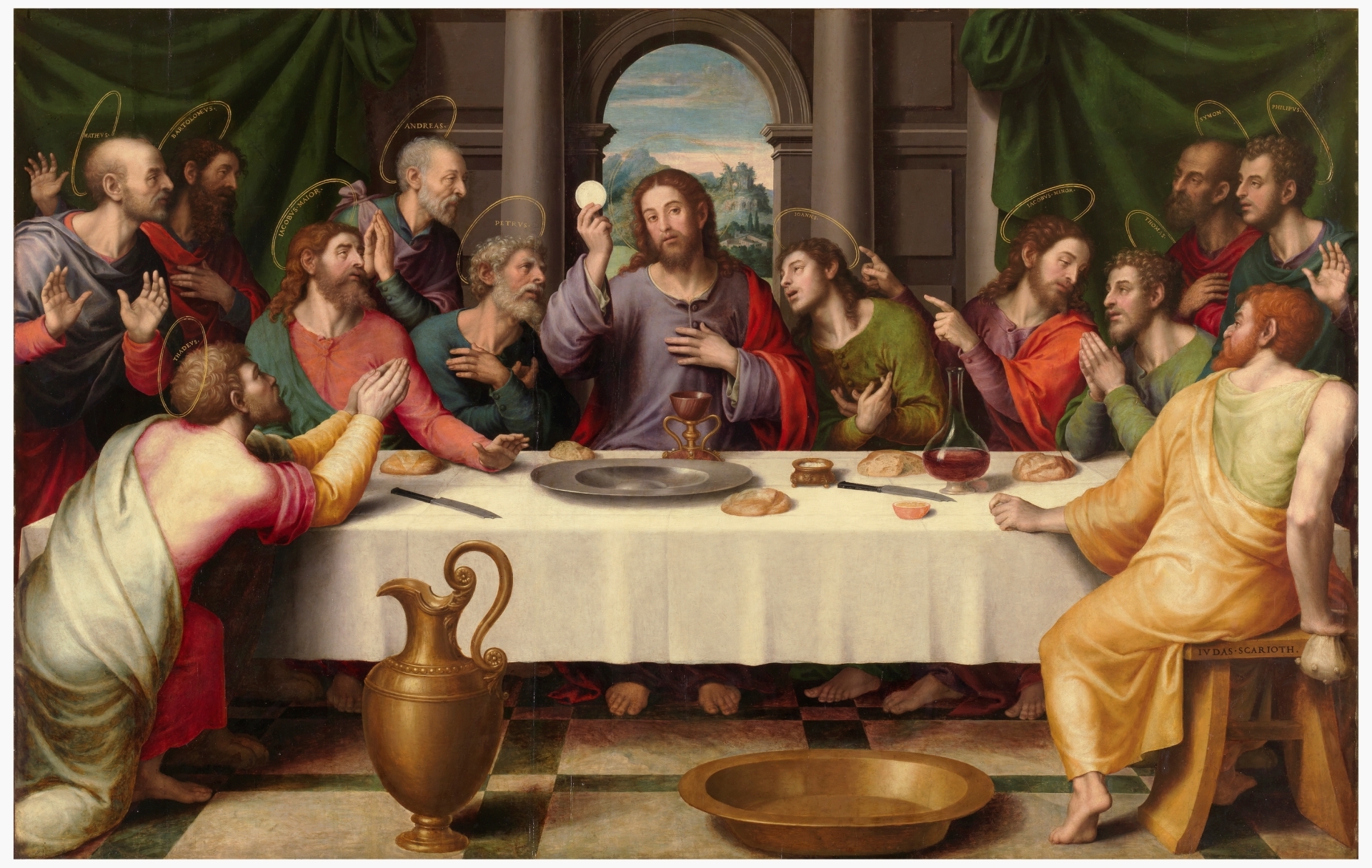
Juan de Juanes, The Last Supper (ca. 1562), is a beautiful rendition of the Last Supper. Here we witness a Eucharistic moment; Christ holding up the sacramental Host. The correlation is clear when seen through the lens of transubstantiation. Notice his gesture: he holds the Host in his right hand while placing his left hand on his chest as to say "Here I am." The scene also holds other treasures. In front of the table are what would have been used to wash the feet of the disciples; a demonstration of the Savior's humility and condescension. To the far, leaning away from the Savior, is Judas Iscariot, holding a bag of coins in his hands; the representation of his betrayal. Note two vital characteristics associated with Judas: 1) he is a redhead; associated with deceit and sin (Mary Magdalene is often represented with red hair also). If you look closely at his face the artist has painted him with a deformed countenance which was common when wanting to depict evil; in this case and many others the reconfiguration of the face is an exaggeration of Jewish facial figures; a clearly anti-semitic trope. A charming aspect of the painting is the little orange sitting on the table. Juan de Juanes was from Valencia; here he gestures towards his origins.

Juan de Flandes, St. James the Pilgrim (1497-1498). I have grown to love this representation of the Saint and seeing it in person has only strengthened that love. The artist has captured the image of an older St. James; mature, kind, and thoughtful. His finger is in the book, perhaps marking a point where he has paused in his reading; he ponders the words from the book. In his right hand he holds the pilgrims staff which reminds its bearer to stave off evil and vice.

Martín Bernat, The Transfer of the Body of St. James the Greater at the Palace of Queen Lupa (1480-1490) represents three key moment involving the arrival of the Saint's body to Spain: 1) the ship sailing towards land; 2) the arrival of the body miraculously to the shores near Finesterre; and 3) the transport of the body by two of his disciples who had remained in Spain (Atanasio and Teodoro). Miraculously the two disciples expected the body's arrival and retrieved it. One of the challenges was with Queen Lupa. She had done much to prevent the Saint's burial. When finally the disciples convinced her to provide a place, she offered a place. However, the obstacles had not ended. In this scene Lupa has told them that they can transport the body. They tell her that they need two oxen which she gives them. However, the oxen were known for being untamed and unmanageable. When the disciples go to retrieve the oxen they submit quietly to being yoked to the cart. The miracle impresses Lupa so much that she converts to Christianity.


Bartolomé Bermejo, Santo Domingo de Silos Enthroned as Bishop (1474-1477). This beautiful piece is more than a glossy enthronement. We should turn our attention to the representation of the seven virtues that all good people should reflect in their life, especially those tasked with great ecclesiastical responsibilities. They are the three theological virtues of Faith, Hope, and Charity and the four cardinal virtues of Prudence, Temperance, Justice, and Fortitude. The three theological virtues are those located highest and surround the head of Saint Dominic. Charity is just above his head (since we are told in 1 Corinthians 13 that it is the greatest of all characteristics) with Hope on the right side and Faith on the left. The other four figures are, beginning on the top left-hand side: Justice, Fortitude; on the right-hand side, top to bottom, Prudence and Temperance. 


Wednesday, April 27, 2022

MUSEO DE ARQUEOLOGICO NACIONAL

On Tuesday (April 26) we had a unique opportunity while visiting the National Archaeological Museum in Madrid. We were allowed to enter the vault where the museum holds its numismatic collection. The collection holds over 300,000 coins. Our purpose was to see coins from the middle ages that were associated with the Camino and the commerce that ran along its length. Most of the coins were from the 11th - 13th centuries; made of both silver and gold. Here is the vault. What you see on the counters are catalogued coins from the vault.


Behind every door there are treasures. Though we were there to see the coinage from the Camino, we had the extra luck to also see coins that had been minted in the 4th century ACE with the profile of Alexander the Great (two of which I held in my hand for a brief moment!).

We learned a lot about how the coins were minted. Because the Camino attracted people from all over Europe there wasn't a single currency until some of the kings in Spain began to provide the means for local coinage to be made and used. The "Christian" coins always had a cross on one side and a Crismon on the other. 

All the coins were relatively small and very thin since they were not poured from molten ore but were stamped pieces. For that reason the shapes were often irregular. In the 12th century you began to see the likeness of the rulers stamped on the coins. The most interesting was one with Queen Urraca that was minted in Toledo. It is unusual because in order for her image to appear on the coin there had to be a granting of permission from the ruler. As a women she might not have had equal consideration but as a powerful queen the permission was given and the coin minted.


The Crismon (Chi-Rho) was a typical symbol associated with Christianity. 


Below are some of the coins that we saw.

Oldest of the coins that we saw.

The was a "fake" or imitation of the coinage minted by the Arabic gold coinage seen below.


Here you see the Crisom (Chi-Rho) symbol.

(Bottom) Minted during the reign of Alfonso VII, King of Castilla and Leon (12th century)


This one has the "Tree of Jesse" on the back

This coin also has a version of the "Tree of Jesse" on the back.


The inverse of the King King Æthelred the Unready (c. 980)

The face on this coin is that of King Æthelred the Unready (c. 980)


The center of this coin holds the crest of Castilla and León. Minted in the 12 century.


This is a coin from Great Britain. The ship signifies the countries dominance of the ocean.


Note that in the center you will see wording in both Spanish and Arabic


Saturday, April 23, 2022

ALCALA DE HENARES - PREPARING FOR THE JOURNEY

I arrived this morning (4/23) in Spain and have settled into the residence in Alcalá de Henares where the group will be for the next two weeks before we begin our trek. I thought that I would give you a quick look at some of my favorite places Alcalá with a little explanation on each one.


Let's start at the Plaza Cervantes that is at the core of the old city. It is a lovely place where people come to stroll about and book sellers set up stands. The tower belonged to a church that is to be the one where Miguel de Cervantes, the author of Don Quixote de la Mancha, was baptized. 


Today the remaining part has been turned into an exhibition hall and the open area that was once the nave has become a skateboard park for the local youth! 

From the plaza you turn down the Calle Mayor. It is like stepping back in time. The street is lined with shops (on the lower level) and residences on the upper. There are a few interesting little tidbits of information that make this are particularly interesting.


First, the second floor overhangs a columned walkway where businesses are located. Access to the residences was from a narrow doorway that opens up onto the business level of the walkway. I order to allow visitors into the private areas above ground the family had a small opening in the floor above the door where they could drop the key and allow entrance to visitors (see below).


Also, take a close look at the columns. Many of them are "repurposed" from the ruins of Roman constructions in what Alcalá once was, the city of "Complutum."

On this same street is the home of Miguel de Cervantes.


If you turn the corner here you will find the Convento de las Carmelitas Descalzas de la Purísima Conception (Covent of the Discalced Carmelites of the Immaculate Conception) also known as the Convento de la Imagen (Convent of the Image). It was established by sor María de Jesús in 1563. Saint Teresa de Jesús, the well-known mystic, visited the convent on numerous occasions.

Backing up to the Calle Mayor, we proceed toward the far end of the street where we find the Catedral Majestral de los Santos Justo y Pastor. It is a late Gothic style (1497) under the supervision of Cardinal Cisneros. 


There are two things to notice here that are of great interest. First, this is the beginning of the Camino de Santiago Complutense that winds north until it meets the French trail (that we will be walking) in León. Also, you will note that on the tower of the Cathedral are storks nests. The birds are protected and left undisturbed. They are seen as being a sign of fortune. (see both below)


From the Cathedral move towards the Plaza de las Bernardas flanked by the Monasterio de San Bernardo and the Convento Madre de Dios. Contiguos to the plaza is the Archbishop of Toledo's palace with its Torreón de Tenorio. The tower was named for the 14th-century Archbishop Pedro Tenorio who served from 1377-1399. Here again you see the "recycling" efforts of early builders to use the precious stone left from the Roman ruins of Complutum.


I wind my way back to the Plaza Cervantes to a final stop (for the moment): la Universidad de Alcalá de Henares. One of a several "institutions of higher learning: the university was "refounded" under the hand of Cardinal Cisneros in 1499.


Welcome to Alcalá. I will continue to post items as the days move along.


Monday, March 7, 2022

Walking the Camino: Three Governing Principles...


Seek knowledge and the influence of the Spirit
. Discover ways of connecting with God. Joseph Smith reminds us that, "The things of God are of deep import: and time and experience, and careful and ponderous, and solemn thoughts can only find them out. Thy mind, O man! if thou wilt lead a soul unto salvation, must stretch as high as the utmost heavens and search into and contemplate the darkest abyss, and the broad expanse of eternity - thou must commune with God. How much more dignified and noble are the thoughts of God, than the vain imaginations of the human heart!" (Teachings of the Prophet Joseph Smith [1938], p. 137).

Consider the power of the "gift"; whether it is given or received. There is great power in your expression of gratitude. Marcel Mauss wrote, "We must not desire the citizen to be either too good or too individualist nor too insensitive or too realist. He must have a keen sense of awareness of himself, but also of others, and of social reality (in moral matters is there even any other kind of reality?) He must act by taking into account his own interests, and those of society and its subgroups. This morality is eternal; it is common to the most advanced societies, to those of the immediate future, and to the lowest imaginable forms of society. We touch upon fundamentals. No longer are we talking in legal terms: we are speaking of men and groups of men, because it is they, it is society, it is the feelings of men, in their minds and in flesh and blood that at all times spring into action and that have acted everywhere." (The Gift, p. 89

Enjoy the strength and comfort that comes through friendship, kindness, and understanding as you interact with those in our group and those that you will meet along the way. In his De Amicitia, Cicero wrote, "I so enjoy the memory of our friendship, that I seem to have owed the happiness of my life to my having lived with Scipio, with whom I was united in the care of public and private affairs, who was my companion at home and served by my side in the army, and with whom - I was in perfect harmony of purpose, taste, and sentiment. Thus, I am now not so much delighted by the reputation for wisdom...as by the hope that our friendship will live in eternal remembrance."


Friday, February 25, 2022

We are back!!! Camino de Santiago 2022

After a two-year delay due to the COVID pandemic, the Camino de Santiago study abroad is back on course. We are so excited to be taking our students to Spain; to experience the spirit of the Camino. We are very grateful to the Kreutzkamps for their generous donation that makes it possible for our students to have this experience.

Ours will be a Road to Emmaus where we will pause and listen and see and feel. In Luke 24 we read:

Road to Emmaus

13 That very day two of them were going to a village named Emma′us, about seven miles from Jerusalem, 14 and talking with each other about all these things that had happened. 15 While they were talking and discussing together, Jesus himself drew near and went with them. 16 But their eyes were kept from recognizing him. 17 And he said to them, “What is this conversation which you are holding with each other as you walk?” And they stood still, looking sad. 

___________

28 So they drew near to the village to which they were going. He appeared to be going further, 29 but they constrained him, saying, “Stay with us, for it is toward evening and the day is now far spent.” So he went in to stay with them. 30 When he was at table with them, he took the bread and blessed, and broke it, and gave it to them. 31 And their eyes were opened and they recognized him; and he vanished out of their sight. 32 They said to each other, “Did not our hearts burn within us[e] while he talked to us on the road, while he opened to us the scriptures?” 33 And they rose that same hour and returned to Jerusalem.... (Luke 24)